The conservation of a 19th-century guardbook (MS Add.5963) of medieval fragments.
Project cost: £16,448
Grant award: £11,253
Dr Suzanne Paul, Keeper of Rare Books and Early Manuscripts writes: MS Add. 5963 is a 19th-century guardbook containing 68 manuscript fragments, mainly dating from the 12th to the 14th century, which had been recycled as bookbinding components and later collected to make, as the volume’s handwritten title states, a 'Catalogue of Fragments from Ancient MSS on Vellum towards a history of writing'. Both the individual fragments and the guardbook, as a curated collection with a manuscript note by the notable 17th/18th-century collector John Bagford pasted to the endleaf, are the subject of significant scholarly interest.
However, the volume has deteriorated to the point that it cannot safely be consulted in our reading room. Both boards are detached, as are several leaves. The fragments, many of which are illuminated, have become damaged as a result of their housing in the guardbook through the application of adhesives, contact with acidic paper and creasing.
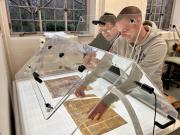
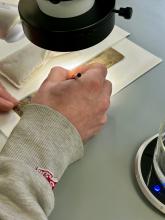
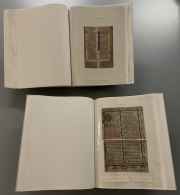
NMCT's grant was used to backfill the role of a Book and Paper Conservator so that he could focus on MS Add. 5963 and gain considerable CPD benefit from it. The conservator to produce a new guardbook in which each fragment encapsulated in a polypropylene enclosure. The notes and provenance evidence from the original guardbook were also be incorporated into the new volume. This conservation work will facilitate digitisation of the fragments (thanks to a grant from AMARC) and their cataloguing. It will then enable the volume to be produced in the reading room and consulted by scholars and the collection to made widely accessible in digital form.
The conservation work has greatly improved the stability of CUL MS Add.5963. In the first instance, this treatment allowed for the safe handling of this volume for digitisation and cataloguing, enabling it to be added to Cambridge University Library’s digital library and in due course as part of the Fragmentarium digital project, making it even more widely accessible. This collection of fragments is now available for further investigation by researchers.