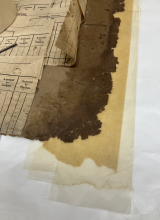
The Glyn Valley Tramway waybill book, 1881-1883
Project cost: £28,295
Grant award: £14,000
Claire Harrington, Principal Archivist, writes: The Glyn Valley tramway was built in 1873 to connect slate quarries at Glyn Ceiriog with the Ellesmere Canal. All traffic going up the Ceiriog Valley was recorded and weighed before continuing its journey to Glyn Ceiriog. For each load a waybill was completed. The bills were kept in a large book (65 x 53cm and comprising 156 pages) with the waybills pasted into it.
Although covering only three years of operation (1881 to 1883), the book is a unique record of what the then residents of the Valley consumed from the outside world – from boots and bricks to gunpowder and quarrying equipment. It is not known that any of the other books which must have existed during the tramway’s life (1873-1935) still survive. Searching TNA Discovery returns few results for waybills and none for waybills kept in the format of this book, which makes this item an extremely rare survival.
The volume is composed of thin paper to which waybills have been pasted, overlapping, on both sides. Damp and rodent attack have left binding, pages and waybills weak and damaged. Overlapping pasting-in also makes it impossible to consult the waybills without further damage. In this condition we cannot allow access at all. However, the information contained is potentially of great interest to historians of the local area, whether of transport, industry or social conditions.
The volume is preserved in its original format, showing how it was made and enabling research into how it was used and why that format was considered the most efficient for its purpose. At the same time, the information contained in each individual waybill will, through digitisation, is readily accessible for research into many different avenues of social, transport and industrial history, and for school project work in the fields of mathematics and science as well as history.
The NMCT grant enabled us to employ a newly qualified conservator, who has gained valuable experience, and further funding from Welsh Government has made possible an extension to her employment enabling her to complete the conservation work. The digitisation of the volume was undertaken by volunteers who benefitted from training in document handling and in the digitisation process.
This project has the added benefit of enabling the volume to be used as a key part of our engagement programme with schools. Literacy, numeracy and digital competence are mandatory cross-curricular skills within the new Curriculum for Wales. It has great potential to contribute to the development of numeracy skills in young people in a novel and exciting way: it presents an opportunity for students to engage with the heritage of their local area within a humanities or mathematics setting. Our Community Engagement Officer is very excited at the prospect of having this material available as a basis for some interesting project material.
As soon as the volume came into the North East Wales Archives we realised its value but also the enormity of the task required to make it accessible. We are very grateful to NMCT for making this project possible.
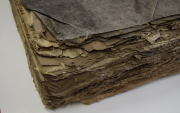
Before - showing the condition of the foredges.
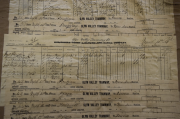
Before - showing the overlapping waybills pasted in.
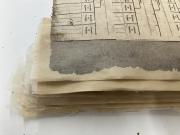
Foredge repairs in progress.