Conservation of the collection of Wiltshire material of J E Jackson
Project cost: £21,048
Grant award: £21,048
Kat Petersen, Archivist, writes: Canon J E Jackson FSA (1805-1891) was rector of Leigh Delamere as well as librarian to Lord Bath at Longleat. He was a keen antiquary and local historian, and collected a large amount of material relating to Wiltshire, with a view to writing a history of the county.
This material – notes, press cuttings, printed ephemera, drawings and sketches as well as some original medieval deeds, engravings and correspondence – was donated to the Society of Antiquaries on Jackson’s death as a vast number of loose items. Rev. C W Shickle FSA arranged the collection in the 1920s and chose to mount the items into 14 huge double-foolscap sized (17in by 27in) volumes.
Over time these volumes became very damaged and worn as the pages were so heavy that the spine could not support them. This additionally caused the lower edge of the pages to sag against the shelf, while the many pasted-in items fanned out the pages, allowing dirt and dust to enter. All of this contributed to the gradual deterioration of the material.
As the Society does not have an in-house conservator, we worked with the paper conservation course at the City & Guilds of London Art School (CGLAS). A team of seven second-year students were recruited to carry out the project, led by their tutor Graeme Gardiner ACR, who is also a freelance conservator. This not only gave the students valuable experience but we were able to pay them!
One of the students, said: ‘This has been a really brilliant opportunity for all of us from CGLAS. We have gained valuable experience managing a large volume of work within a tight deadline, and the responsibility of working on a collection outside of university has also been a great learning experience. We have all really enjoyed our time at the Society of Antiquaries, and were so proud to see the collection laid out in its new archival boxes when we were finished. I am so grateful to the Society and to the National Manuscripts Conservation Trust for this opportunity and for the trust that they have placed in us as conservators, and I hope that future CGLAS students will be able to have similar experiences.'
The Society closes every year for the month of August to carry out behind-the-scenes tasks, which gave us the time and space to carry out this project in a very short period, as we converted four large library desks into makeshift conservation stations.
Each volume was disbound and the folios cleaned. Basic repairs such as flattening creases and mending small tears were carried out. Each folio was then put into an archival-quality paper folder.
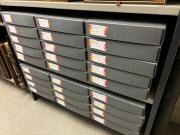
Inevitably the dis-binding and repackaging converted each volume into between two and four boxes, the contents of which have since been listed by an archive volunteer. In addition to making it easier for researchers to access specific items in the collection, it is now much easier for staff to retrieve a reasonably-sized box instead of a large and unwieldy volume weighing up to 12 kilos!
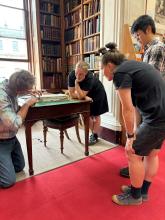
Conservator demonstrating disbinding to the students.
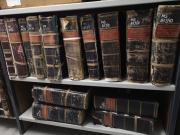
The huge volumes before conservation.